Impact Wrench vs Torque Wrench: Which Do Wheels Need? (October 2026)
For an impact wrench vs torque wrench decision, use an impact wrench for powered lug-nut removal and a torque wrench for final tightening. A manual lug wrench can handle removal, so buy the torque wrench first if you already have a suitable removal tool.
On this page (11 sections)
- Impact wrench vs torque wrench: what's the difference?
- Which tool should you buy first for wheel work?
- Which tool should you use to remove lug nuts?
- How do you choose a torque wrench for wheels?
- Which tool should you use to tighten lug nuts?
- Can you use an impact wrench to run lug nuts down?
- Does your battery platform change the buying decision?
- What should you check before tightening a wheel?
- Which mistakes should you avoid with both tools?
- How do you care for an impact wrench and torque wrench?
- Impact wrench vs torque wrench: which should you choose?
An impact wrench removes lug nuts quickly, while a torque wrench controls final tightening to the vehicle's specification. The impact wrench vs torque wrench choice is about two different jobs, not two ways to do the same job.
For occasional wheel changes, a manual lug wrench and a suitable torque wrench can cover both tasks. Add a powered impact wrench when frequent removal makes the extra tool worthwhile.
The 3 products below are impact wrenches for the removal side of that setup. None replaces a torque wrench, and you don't need one of these high-torque models just to install a wheel correctly.

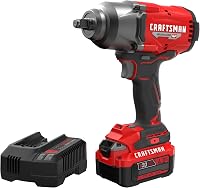
 Best for first-time cordless buyers
Craftsman V20 RP 1/2 Inch Impact Wrench Kit
Impact wrench vs torque wrench: what's the difference?
An impact wrench delivers repeated rotational blows, while a torque wrench measures or signals applied tightening torque. One saves effort moving fasteners; the other helps you reach a specified setting.
An impact wrench turns a socket using battery, air or corded power, depending on the model. Once resistance rises, its hammer mechanism adds blows that help break a fastener loose.
A torque wrench works differently. A click wrench signals at its setting, a beam wrench shows torque on a scale, and an electronic wrench uses a display or alert.
Most click wrenches don't physically stop you from pulling farther. You must recognize the signal and stop, following the instructions for that tool.
The guide to removing lug nuts with an impact wrench covers powered removal. For jobs beyond wheels, see what an impact wrench is used for.
Impact wrench versus torque wrench: power isn't precision
Maximum output is a capability figure, not a selectable wheel setting. Holding an impact wrench's trigger for a certain number of seconds doesn't produce a dependable final torque.
Fastener condition, socket setup, battery condition and joint stiffness all affect the result. A low-speed mode can improve control without making the tool a calibrated torque wrench.
Breakaway torque concerns loosening, while fastening torque concerns tightening. Neither figure replaces the installation value specified for your vehicle and wheel combination.
Which tool should you buy first for wheel work?
Buy a torque wrench first if you already have a suitable removal tool. Buy an impact wrench when removal effort or repeated work is the gap in your kit.
A driver changing wheels once or twice a year can often manage with a lug wrench or suitable breaker bar. That approach also avoids maintaining a battery just for rare use.
A home mechanic rotating tires across several vehicles gets more value from powered removal. The time saved grows with the number of fasteners you remove, especially when you also do other suitable automotive work.
Skip a large high-torque impact wrench if your main jobs involve small fasteners or tight spaces. Access, control and socket clearance matter more there than the largest advertised torque figure.
Also consider where the car lives. A cordless tool needs a charged battery, while a manual removal tool remains useful as a backup when the battery is flat.
Use our guide to choosing an impact wrench to weigh the anvil, battery platform and intended jobs before committing to a kit.
Which tool should you use to remove lug nuts?
Use an impact wrench, lug wrench or suitable breaker bar for removal. Reserve the torque wrench for tightening unless its manufacturer expressly permits loosening.
Follow the vehicle's instructions for parking, wheel chocking, lifting and support. With manual removal, the instructions may call for initially loosening the nuts before lifting the wheel clear.
Fit an impact-rated socket of the correct size to an impact wrench. Seat it fully on the nut, keep the tool aligned and stop if the socket slips or the fastener begins to round.
For demanding removal work, DeWalt rates the DCF900P1 at 1,400 ft-lb maximum breakaway torque. Its Precision Wrench control is designed to help reduce overtightening in forward and fastener run-off in reverse.
Choose this kit if stubborn fasteners are a regular part of your work and you need the battery and charger too. Skip it if a manual tool already handles your occasional wheel changes comfortably.
Don't keep hammering indefinitely when a nut won't move. Stop to check the socket fit, rotation direction and fastener condition before choosing another removal method.
Our guide to impact wrench torque for lug nuts explains why removal capability and a wheel's installation target are different numbers.
How do you choose a torque wrench for wheels?
Choose a torque wrench whose working range covers your required setting and whose drive fits suitable sockets. Check your vehicle's torque requirement before choosing the wrench.
Read the units carefully. Foot-pounds, inch-pounds and newton-meters aren't interchangeable, and confusing them can produce a badly wrong setting.
A click wrench suits buyers who want a clear physical signal without watching a scale. A beam wrench needs a clear view of its pointer, while an electronic model needs working batteries and attention to its alerts.
Check how the handle locks, how easily you can read the scale and whether the wrench signals in the direction you need. These details matter more than a wide range you won't use.
Allow enough room to pull smoothly on the intended grip. A wrench that barely fits beside a tire may be awkward to use correctly even when its torque range is suitable.
Skip a wrench whose required setting falls outside its stated range. Also avoid choosing solely by length or drive size, since neither tells you the tool's usable torque range.
Which tool should you use to tighten lug nuts?
Use a torque wrench for the final tightening stage, following the applicable torque value and sequence. Start with correct wheel seating and hand-threaded nuts, not power.
Check that the wheel sits flush against the hub and that each nut turns freely by hand. A nut that binds early may be misaligned or damaged; more force won't correct that.
Bring the nuts into contact evenly using the specified sequence. Don't fully tighten the first nut while the others are still loose.
Follow the vehicle's instructions for the wheel's position during final tightening. Apply force smoothly at the torque wrench's designated grip and stop at its signal or target reading.
Overtightening can damage studs, nuts or wheel seating surfaces. Undertightening can let the wheel work loose, so neither extra effort nor a guess by feel is a useful substitute for the specified procedure.
After finishing, make sure every nut received the final pass. A consistent starting point and sequence help prevent accidentally skipping one.
Can you use an impact wrench to run lug nuts down?
Powered run-down is possible, but manual snugging is easier to control for occasional wheel work. An impact wrench can pass the required torque before you release the trigger.
Hand-thread every nut several turns before applying power. Keep the socket straight and don't use the tool to force a reluctant nut onto a stud.
If you use powered run-down, stop before impact blows tighten the joint. Continue with the vehicle's seating procedure and finish with the torque wrench.
The Craftsman CMCF940M1 offers speed and trigger control for powered work. Craftsman rates it at 700 ft-lb maximum tightening torque and 1,000 ft-lb breakaway torque, so it still demands care around wheel fasteners.
This is a practical starting point if you need a complete cordless setup. Skip the kit if another battery platform already meets your needs and buying another charger would add clutter.
An immediate torque-wrench click doesn't prove an impact-tightened nut is correct. The nut may already be too tight; follow the installation procedure again rather than simply accepting the click.
For a step-by-step removal workflow, read how to use an impact wrench to remove lug nuts. For grip, alignment and socket handling, see how to use a cordless impact wrench.
Does your battery platform change the buying decision?
An existing battery platform can make a compatible bare tool the sensible choice. Starting from nothing makes a kit with a battery and charger easier to assemble.
Check what the package includes before comparing tools. A bare impact wrench isn't ready for cordless work until you have both a compatible battery and a way to charge it.
The Milwaukee 2767-20 is a bare tool compatible with M18 batteries. Milwaukee rates it at 1,000 ft-lb fastening torque and 1,400 ft-lb nut-busting torque.
Choose it if you already have the M18 battery and charging setup and need high-torque removal capability. Skip it as an automatic first choice if you must also buy the supporting equipment for rare wheel work.
Our complete cordless impact wrench buying guide explains platform choices. Compare impact wrench sizes if other car jobs matter as much as lug nuts.
What should you check before tightening a wheel?
Check the correct torque, fastener condition and wheel seating before reaching for either tool. The instructions must apply to your vehicle, wheels and fasteners, especially if parts have changed.
Confirm that replacement lug nuts have the correct thread and seating shape for the wheel. A nut can thread onto a stud yet have the wrong seat, so thread fit alone isn't enough.
Remove dirt or corrosion that prevents proper seating using the applicable service guidance. Stop if threads, studs or seating surfaces show damage.
Don't add oil, grease or anti-seize unless the relevant instructions require it. Lubrication changes the relationship between applied torque and clamping force.
Check any wheel-maker instructions for staged tightening or a later torque recheck. Don't substitute a universal torque number or recheck interval for the guidance that applies to your setup.
Which mistakes should you avoid with both tools?
Avoid using extra force to cover up uncertainty. Wrong units, poor seating and damaged threads need correction before final tightening.
- Using ordinary sockets on an impact wrench: choose impact-rated sockets and accessories suitable for the tool.
- Treating a speed mode as a torque setting: speed control doesn't establish final wheel torque.
- Starting nuts under power: hand-thread them first so you can feel binding.
- Adding extra clicks: stop at the wrench's signal instead of pulling again for reassurance.
- Extending the torque wrench's handle: don't add a pipe for leverage unless its manufacturer allows the setup.
- Ignoring adapters: an offset adapter can change effective leverage and may require a setting correction under the tool's instructions.
- Using the torque wrench as a breaker bar: use a removal tool unless the torque wrench's instructions permit that job.
Wear eye protection during powered removal and keep clear of a fastener that is nearly free. Never work beneath a vehicle supported only by a jack.
How do you care for an impact wrench and torque wrench?
Keep the impact setup ready and the torque wrench protected. Basic care helps prevent avoidable interruptions and measurement problems.
Remove the impact wrench's battery before changing accessories or cleaning it. Wipe away dirt, keep vents clear and inspect sockets for cracks, wear or damaged drive openings.
Store and charge the battery according to its instructions. Keep enough charge available before lifting the vehicle rather than discovering a flat pack halfway through removal.
Store a torque wrench in its case where it won't be dropped or used as a general-purpose ratchet. For an adjustable click model, follow its storage-setting instructions rather than assuming zero is correct.
Follow the manufacturer's calibration schedule. A drop, overload or unusual behavior is a reason to have the wrench checked before relying on it for final wheel tightening.
Impact wrench vs torque wrench: which should you choose?
Choose a torque wrench plus manual removal tool for occasional wheel changes. Add an impact wrench when repeated removal or stubborn fasteners justify powered help.
Pick the DeWalt kit for demanding removal with a battery and charger included. Choose the Craftsman kit when you're building a cordless setup, or the Milwaukee bare tool when your existing M18 equipment makes it a better fit.
If your current tools already remove nuts comfortably, improving final-torque control is the more useful next purchase. If final tightening is covered but removal slows every job, shop for an impact wrench that fits your access and battery needs.
The impact wrench vs torque wrench decision ends with a simple workflow: remove with a suitable removal tool, start nuts by hand and finish to the specified torque. Use the lug-nut torque guide to separate removal requirements from the final installation setting.
Frequently asked questions
Can an impact wrench tighten lug nuts?
Yes, but use a torque wrench for final tightening to the vehicle's specification. An impact wrench's output changes with the setup and trigger time, so even a low setting can overtighten a nut; start every nut by hand, and use manual snugging if you can't control powered run-down.
Can I use a torque wrench to remove lug nuts?
Use a lug wrench, suitable breaker bar or impact wrench unless your torque wrench's instructions permit loosening; a reversible head alone doesn't establish that permission. Forcing a stuck nut can exceed the wrench's limits, so check both the permitted direction and torque range before using it for removal.
Do wheel lug nuts need to be tightened in a pattern?
Yes, follow the vehicle or wheel maker's tightening sequence so the wheel seats evenly against the hub; a star pattern is common on 5-lug wheels, but layouts differ. Bring the nuts into contact evenly, then complete the specified tightening stages instead of fully tightening one nut first.
Should I retorque wheels after installation?
Follow the vehicle or wheel maker's instructions for whether and when to recheck wheel torque. Use the specified setting and sequence with a suitable torque wrench; don't add extra pull after its signal, and investigate any nut that repeatedly loosens rather than treating repeated tightening as a repair.