Milwaukee M12 vs M18 Impact Wrench: Which Fits Car Jobs? (October 2026)
For a Milwaukee M12 vs M18 impact wrench choice, pick the M18 3/8-inch compact for fastening controls, the M18 1/2-inch compact for existing wheel sockets, or the M12 Stubby for an M12 tool kit. Match your batteries, sockets and working space before choosing.
On this page (11 sections)
- Milwaukee M12 vs M18 impact wrench: what changes?
- Which anvil size makes more sense for car jobs?
- How do the stated torque figures compare?
- Which compact wrench fits your tool kit?
- What should you choose for wheel work?
- Is an M12 wrench enough for home mechanics?
- How should you set up and use the wrench?
- Which mistakes should you avoid?
- How do you care for a compact impact wrench?
- Which Milwaukee M12 vs M18 impact wrench should you pick?
- Sources
For a Milwaukee M12 vs M18 impact wrench, choose the M18 3/8-inch compact for selectable fastening controls, the M18 1/2-inch compact for existing wheel sockets, or the M12 Stubby for an M12 kit. Your battery system and socket collection should narrow the choice first.
These are 3 specific compact wrenches, not a verdict on every tool in either platform. A larger battery-platform number doesn't automatically mean more loosening torque or a better fit for your repairs.
Start with the fasteners you reach most often: wheel nuts, brake hardware, suspension bolts or small brackets. Then check whether the complete wrench-and-socket setup fits those jobs.
 Best for M18 repair work
Milwaukee M18 FUEL 3/8 Inch Compact Impact Wrench
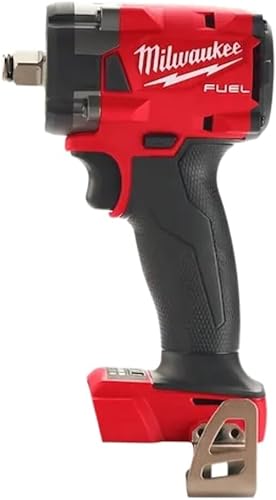 Best for existing wheel sockets
Milwaukee 2855-20 M18 FUEL 1/2 Inch Compact Wrench
Milwaukee M12 vs M18 impact wrench: what changes?
The main differences are battery compatibility, socket connection and fastening controls. Choose the combination that fits your daily work rather than treating M12 and M18 as power rankings.
If you already have compatible batteries and a charger, staying with that platform can avoid buying a second setup. Starting fresh gives you more freedom to choose around the wrench itself and other tools you expect to add.
The M18 3/8-inch compact and M12 Stubby are bare tools. For the M18 1/2-inch option, confirm the package contents before ordering so your first repair doesn't stall over a missing battery.
A charger that accepts more than one battery family doesn't make the batteries interchangeable. Check the tool, battery and charger instructions as separate parts of the setup.
Does a Milwaukee M12 or M18 impact wrench fit tight spaces better?
Neither platform wins on body length alone: the M12 Stubby and M18 3/8-inch compact both measure 4.8 inches, while the M18 1/2-inch compact measures 4.9 inches. That small gap matters less than the room needed for your socket and battery.
Measure access along the fastener's axis, where the wrench must sit squarely behind the socket. Also check side clearance for the handle, battery and your hand.
A deep socket can reach a recessed nut but may make the setup too long beside a frame rail. A shallow socket may fit better where the fastener doesn't require extra depth.
Don't use a partly seated socket to gain clearance. If a straight approach isn't possible, compare other tool shapes in our compact impact wrench guide.
Which anvil size makes more sense for car jobs?
Choose the drive size your most-used impact sockets already have. The M12 Stubby and M18 3/8-inch compact accept 3/8-inch sockets, while the M18 1/2-inch compact accepts 1/2-inch sockets.
Drive size describes the square connection, not the fastener size. A socket's marked opening must match the nut or bolt head, regardless of which wrench drives it.
For wheel work, inspect your lug socket before choosing. For brake and bracket work, lay out the sockets you actually use rather than buying around a set you might need later.
Our guide to 1/2-inch vs 3/8-inch impact wrenches explains the tradeoffs in socket size and access.
An impact-rated adapter can bridge a mismatch, but it adds length and another connection. Choose a direct fit for frequent jobs, and reserve adapters for occasional needs.
Use impact-rated accessories throughout the setup. A regular chrome hand socket isn't a substitute simply because it fits the anvil.
How do the stated torque figures compare?
Milwaukee claims up to 550 ft-lb of nut-busting torque for the M12 Stubby, compared with up to 250 ft-lb for each M18 compact here. These are loosening claims, not selectable wheel-tightening values.
This comparison is a clear reason to judge individual models instead of assuming an M18 wrench must be stronger. It also doesn't establish that the M12 will remove every fastener the M18 tools cannot.
Corrosion, damaged threads, previous overtightening and the accessory setup all affect removal. A wrench also needs room to keep the socket fully engaged and aligned.
A vehicle's tightening specification serves a different purpose from a tool's maximum loosening claim. Use a torque wrench for final wheel tightening rather than trying to translate one number into the other.
If wheels are your main job, our guide to impact wrench torque for lug nuts explains how to think about removal needs.
Which compact wrench fits your tool kit?
Choose the M18 3/8-inch model for its controls, the M18 1/2-inch model for socket fit, or the M12 Stubby for an M12-based kit. Each has a clear buyer, and none needs to cover every repair.
Milwaukee M18 FUEL 3/8 Inch Compact Impact Wrench
Buy this model if you already use M18 batteries and want a compact wrench for mixed repair work. Its 4-mode DRIVE CONTROL lets you select preset speed and impact levels instead of relying only on trigger pressure.
Milwaukee says auto shut-off applies no more than 20 ft-lb for hand-tight fastening applications. That helps limit initial fastening, but it isn't a suitable finishing method for every small bolt.
Bolt Removal Control reduces RPM after a bolt loosens, helping you manage the transition from breaking it free to spinning it off. Tri-LEDs around the anvil help illuminate recessed hardware.
Skip this model if most of your work uses 1/2-inch sockets and you want to avoid adapters. For delicate threads or low-torque hardware, plan to use a hand tool regardless of the available modes.
Milwaukee 2855-20 M18 FUEL 1/2 Inch Compact Wrench
Buy the 2855-20 if your M18 kit and 1/2-inch impact sockets already cover wheel and chassis work. The direct socket connection keeps a routine setup simpler than using a drive adapter each time.
Automatic shut-off helps with initial fastening, while bolt removal mode slows rotation once the bolt loosens. Its 3 LEDs illuminate the area around the fastener.
Skip it if your repair kit mostly uses 3/8-inch sockets or if seized hardware is your main reason for buying. Its larger socket connection doesn't give it a higher claimed loosening figure than the other M18 compact here.
This is a compact tool choice, so check the demands of your hardest recurring job. Don't buy it solely because 1/2-inch drive sounds like the strongest option.
Milwaukee M12 FUEL 3/8 Inch Stubby Impact Wrench
Buy the M12 Stubby if you want an M12 repair kit with 3/8-inch impact sockets. Its 2 lb tool weight is useful to consider for repeated positioning, though the battery and socket add to the working weight.
Its claimed loosening capability makes it a serious candidate for car repairs beyond small brackets. Choose it because that capability and platform fit your needs, not because “Stubby” guarantees the smallest complete setup.
Skip it if you're satisfied with your M18 batteries and don't want another charging system. Also skip it if your regular jobs depend on direct use of 1/2-inch sockets.
Don't assume this model has the same control modes described for the M18 options. If a particular fastening feature drives your choice, choose a wrench with that feature confirmed.
What should you choose for wheel work?
For wheel work, prioritize socket fit, removal needs and a proper final-tightening process. Choose your battery platform after confirming that the wrench suits the actual wheel setup.
The M18 1/2-inch compact is the straightforward choice if that drive matches your lug sockets. Either 3/8-inch model can fit a wheel kit built around matching impact sockets.
Check whether the socket reaches the lug nut without contacting the wheel. Fully seat it before pulling the trigger, especially on recessed fasteners where engagement is harder to see.
A compact wrench can be useful for routine wheel removal without being the right answer to every badly seized nut. If the socket slips or the fastener shows damage, stop and reassess the removal method.
Follow the vehicle manual for lifting points, support and wheel installation. Our guide to removing lug nuts with an impact wrench covers the process in more detail.
Is an M12 wrench enough for home mechanics?
The M12 Stubby is a sensible home-mechanic choice when your batteries, sockets and access needs fit it. Buying an M18 tool solely for the platform name adds little if the specific compact model doesn't solve a different problem.
Write down your next few likely repairs before buying. Separate accessible wheel fasteners from cramped brake hardware and heavily corroded suspension bolts.
That list helps you spot where an impact wrench saves time and where a breaker bar, ratchet or specialist removal method still belongs. You don't need every repair to use the same tool.
Our cordless impact wrench buying guide covers the wider category. For a closer check of torque, drive and battery choices, use how to choose an impact wrench.
How should you set up and use the wrench?
Start with a charged compatible battery, a sound impact socket and clear access to the fastener. Read the tool manual before selecting a mode, especially where a control changes behavior after loosening.
Inspect the socket for cracks or worn corners, then make sure it locks onto the anvil as intended. Remove the battery before changing accessories or inspecting the tool.
Wear eye protection and keep loose clothing away from rotating parts. Support the wrench so you can maintain alignment without putting your free hand near moving components.
For removal, confirm the direction and keep the socket square. Use short, controlled trigger pulls so you can notice slipping, movement of the assembly or a fastener that isn't responding.
Once a bolt breaks free, reduce speed and support any part it secures. Slower rotation doesn't stop a loose bracket, caliper or other component from moving when its final bolt comes out.
For installation, start threads by hand and check that the parts sit correctly. Use powered run-down only where the relevant instructions allow it, then finish with the specified procedure.
Which mistakes should you avoid?
Avoid prolonged hammering, forced access and finishing by feel. These habits can turn a simple removal or installation into damaged hardware.
If repeated short attempts don't move a fastener, stop and check the direction, socket engagement and repair instructions. More trigger time isn't a substitute for finding out why the joint won't move.
Don't force the wrench sideways to reach around an obstruction. A longer accessory stack may reach the fastener while making it harder to keep the socket aligned.
Don't run a small bolt down hard just because the wrench has an automatic mode. Thread size, material and the repair specification determine how carefully it needs to be tightened.
For wheels, a torque wrench and impact wrench serve different roles. Trigger feel, sound and the number of impacts don't confirm final torque.
How do you care for a compact impact wrench?
Keep the tool clean, accessories sound and batteries within their care instructions. Basic checks before storage are easier than finding a damaged socket or empty pack halfway through a repair.
Remove the battery before cleaning, and wipe away dirt with a dry cloth. Keep vents clear and avoid directing liquid into the housing, switch or battery contacts.
Inspect the anvil and socket-retention parts for damage or poor engagement. Stop using an accessory that no longer stays attached properly.
Store the wrench and sockets somewhere dry, away from leaking vehicle fluids. Follow the battery instructions for charging and storage, and let an unusually hot tool or pack cool before continuing.
Don't open the housing or add lubricant unless the manual calls for it. Internal service needs the correct procedure and parts.
Which Milwaukee M12 vs M18 impact wrench should you pick?
Choose the M18 3/8-inch compact if you want its selectable controls for mixed repairs. Choose the M18 1/2-inch compact if direct connection to your existing wheel sockets is the deciding factor.
Choose the M12 Stubby if you're building around M12 batteries and want a 3/8-inch wrench with a higher claimed loosening figure than these M18 compacts. Staying with M18 still makes sense when it covers your jobs and avoids a second battery system.
Before settling your Milwaukee M12 vs M18 impact wrench choice, check your most-used socket and the hardest space you need to reach. If none of these fits that job, compare the wider range in our Milwaukee impact wrench guide.
Sources
Milwaukee's model pages offer further reference for the 2855-20 and 2562-20. Use the tool manual for operation and the vehicle manual for repair procedures and torque specifications.
Frequently asked questions
Is Milwaukee M12 or M18 better for car work?
Choose the specific wrench around your batteries, socket drive and usual repairs. The M12 Stubby suits an M12 kit, while these M18 compacts offer a choice of socket connections.
For mixed car work, access and fastening controls deserve as much attention as the platform name.
Can a Milwaukee M12 impact wrench remove lug nuts?
The M12 Stubby is a reasonable candidate for lug-nut removal, with Milwaukee claiming up to 550 ft-lb of nut-busting torque. Rust, damaged threads and previous overtightening can still prevent removal.
Use a correctly sized impact socket and follow the vehicle manual for wheel removal, support and installation.
Should I choose a 3/8-inch or 1/2-inch impact wrench?
Choose the drive that matches the impact sockets you use most often. Both sizes can serve car work, but the socket must also fit the fastener and available space.
An impact-rated adapter can bridge drive sizes, though it adds length and another connection between the wrench and socket.
Do M12 and M18 batteries fit the same tools?
Use a battery made for your wrench's platform; M12 and M18 are separate tool systems. Check charger compatibility separately, since a charger may support different packs without making those packs interchangeable.
For a bare tool, include the correct battery and charging setup in your buying plan.
Can an impact wrench tighten lug nuts safely?
Start lug nuts by hand and use a torque wrench for final tightening to the vehicle maker's specification and sequence. Use an impact wrench for initial run-down only when the applicable manuals allow it.
Automatic shut-off limits a tool's fastening action, but it does not confirm the wheel's final torque.


